 Spacefi
 Spacebase added a mining bonus for creators and invited members
Spacefi Spacebase gave creators and invited members an additional 5% bonus on the invited member’s SPACE mining rewards. Each side received its own extra allocation based on those earnings, so the deposited asset balance wasn’t the calculation base. Under the historical SPACE-based rules, creating a group or buying more membership places required a separate SPACE payment, with a different allocation.
The project subsequently announced April 30, 2026 as its closure date. That announced deadline has passed, leaving current access to individual groups and rewards uncertain. The SPACE-based rules describe the historical community system.
An invitation linked both bonuses to member earnings
The creator and the invited member each received an extra reward under the historical 5% rule. The invited member’s mining earnings supplied the calculation base for each allocation. They didn’t split a single 5% allowance.
Creation and joining involved different commitments
The creator’s group
Creating a Spacebase required SPACE in the historical community design, and creators could invite others into their groups. SpaceFi’s separate Create a Spacebase guide specified STAR for creation and let creators choose the initial member quota. That guide limited each address to creating or joining one Spacebase. The historical SPACE payment followed its own burn and fee allocation. That spending concerned the group itself, while the invited member’s farming activity supplied the earnings on which both bonuses depended.
The invited member’s participation
An invited member joined an existing group and earned mining rewards through farming. Accepting an invitation established the membership relationship; the additional reward still required an underlying mining amount. Membership alone therefore supplied no fixed token payout.
A recorded reward and its calculated bonuses
In this hypothetical historical case, an invited member had joined a creator’s SPACE-based Spacebase before mining. After participating, the member recorded 1285 SPACE in eligible mining earnings.
The 5% rule would allocate 1285 × 0.05 = 64.25 SPACE to each participant. The member’s base reward plus their own bonus would total 1349.25 SPACE in this calculation. The creator’s separate allocation would be 64.25 SPACE. These figures describe calculated amounts, without establishing that either bonus had reached a spendable balance.
If the same hypothetical member remains in the group without a recorded eligible mining amount, membership alone doesn’t determine the bonus amount. Substituting the deposited asset value would change the calculation base and produce an answer that the historical rule didn’t support.
A completed bonus payment would confirm receipt. Changing the eligible mining amount changes both calculated bonuses proportionally. The invitation relationship and the percentage alone don’t supply a payment date.
Membership capacity required a separate SPACE budget
The initial quota
The historical community description specified 10 memberships as the default group capacity. That number counted places, not tokens or a minimum number of active miners. The SPACE cost of creation was adjustable, so the default membership quota didn’t identify a permanent token price for opening a group.
Additional places
Creators could purchase extra membership places with SPACE when their groups needed more room. Those payments followed the same burn and fee split as creation. Expanding capacity allowed additional members to join; the documented mining-bonus percentage remained a separate parameter from the price of those places.
Creation payments funded burning and fee recipients
The historical SPACE-based system burned 90% of the SPACE paid for creating a Spacebase or increasing its membership quota. The remaining 10% formed a handling fee. Of that fee, 70% went into the NFT holder dividend pool and 30% went into the DAO treasury. DAO meant decentralized autonomous organization, and the treasury portion went into locked reserves for ecosystem development.
The 70% and 30% shares used the handling fee as their base. Expressed against the original SPACE payment, the NFT pool received 7% and the treasury received 3%. These allocations concerned the creation or expansion payment, separately from the member’s mining earnings.
NFT holders shared a separate fee entitlement
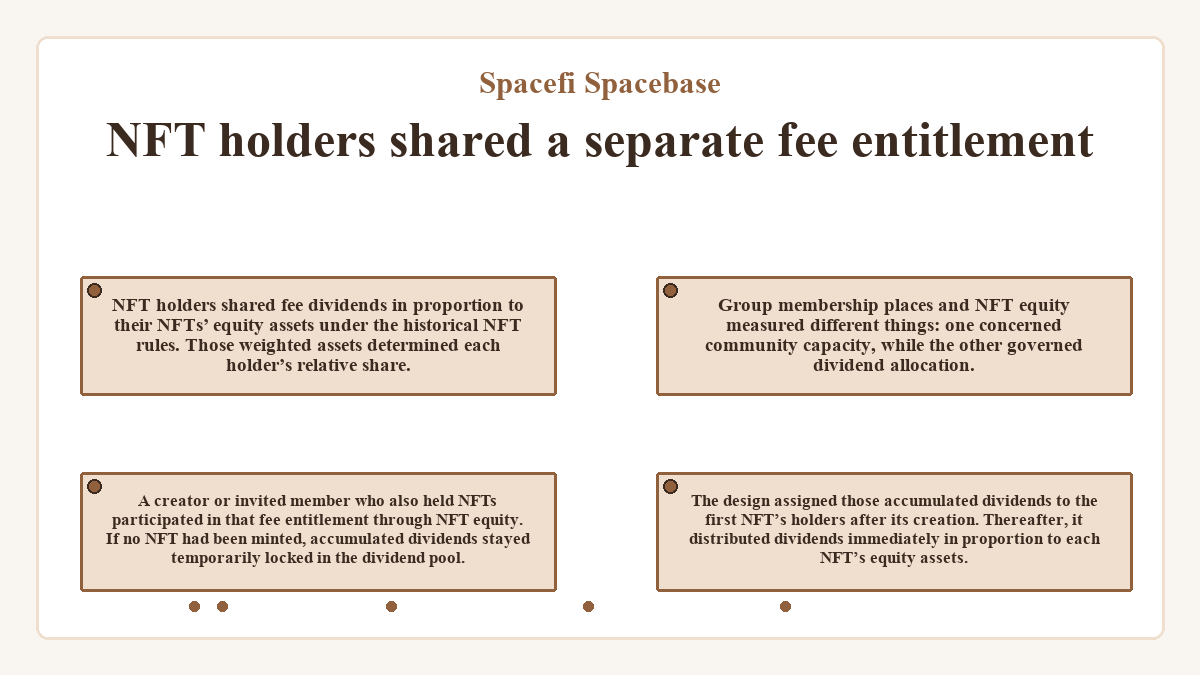
NFT holders shared fee dividends in proportion to their NFTs’ equity assets under the historical NFT rules. Those weighted assets determined each holder’s relative share. Group membership places and NFT equity measured different things: one concerned community capacity, while the other governed dividend allocation. A creator or invited member who also held NFTs participated in that fee entitlement through NFT equity.
If no NFT had been minted, accumulated dividends stayed temporarily locked in the dividend pool. The design assigned those accumulated dividends to the first NFT’s holders after its creation. Thereafter, it distributed dividends immediately in proportion to each NFT’s equity assets.
Base PK rewarded group performance
Spacebase PK provided group competitions with honors and SPACE awards, using measures that included total value locked and member numbers. TVL meant total value locked, a measure of asset value. TOP Base and Popularity Award were named examples of honors. These competitions formed a distinct reward mechanism alongside the invitation-linked mining bonus.
SPACE and STAR belonged to different contract sets
The historical community rules named SPACE for group payments and mining-bonus calculations. On zkSync Era, the version 1.0 contract set listed SPACE and xSPACE, while version 2.0 listed STAR and xSTAR. Those separate token records didn’t establish that every older Spacebase parameter carried over unchanged to the later deployment.
The June 15, 2023 tokenomics adjustment recorded that bridge development between zkSync Era and Evmos had stopped and closed. Products and tokens would continue separately on the two networks. A shared project name therefore didn’t establish a single combined token balance across those deployments.
Proposed extensions went beyond mining bonuses
The historical Spacebase plan envisaged upgrading groups into special NFTs and adding uses in DAO governance and games. It presented those extensions as future development, separately from the creation, capacity and mining-bonus features. That plan didn’t establish a completed rollout of the extensions or a date when membership conferred new governance rights.
The announced deadline and outstanding rewards
The closure notice asked users to withdraw LP tokens from Farm or remove liquidity from the DEX before April 30, 2026. LP tokens represented liquidity-provider positions, and DEX meant decentralized exchange. Those instructions concerned farming and liquidity positions; they didn’t establish the settlement of every Spacebase bonus.
Access to a particular group or outstanding reward after the announced deadline remains uncertain. Anyone dealing with a remaining Spacebase reward needs its actual post-deadline status before treating the historical calculation as a claimable balance.
Spacefi Spacebase - common questions
Was the Spacebase bonus quoted as an annual return?
The historical 5% figure described an extra allocation on a qualifying mining reward, not an annualized return on deposited assets. It didn’t supply a standalone investment period or a yearly earnings projection. Calculating an annual return would also require the amount of mining rewards earned over time and the value of the committed assets.
Could an xSPACE wallet balance reveal the size of a Spacebase bonus?
An xSPACE balance alone couldn’t identify the mining reward used for a Spacebase bonus. The historical token design produced xSPACE through farming and direct 1:1 SPACE locking. A wallet balance could therefore include amounts from different origins. The community bonus calculation needed the amount attributable to eligible mining earnings.
Were LP tokens a payment option for creating a Spacebase?
The historical SPACE-based creation rule specified a SPACE payment. LP-token subscriptions belonged to Starter, the fundraising component, and served a different purpose. Contributing to a token sale didn’t establish that a participant had created a Spacebase or purchased membership places.
Why did older Spacebase bonus descriptions mention both USDT and SPACE?
USDT described the staked asset in the historical bonus illustration, while SPACE described mining earnings and the additional rewards. Similar-looking amounts in those two units didn’t establish an exchange rate or a promised reward for a deposit. The bonus percentage used the SPACE mining amount, leaving the deposited asset value outside that calculation.
Did xSPACE unbonding refund a Spacebase creation payment?
Unbonding xSPACE concerned SPACE locked to obtain xSPACE; it wasn’t a refund of Spacebase creation or capacity payments. The historical community rules allocated those payments to burning and fees. The burned portion of a creation payment wasn’t locked SPACE available for xSPACE unbonding.